

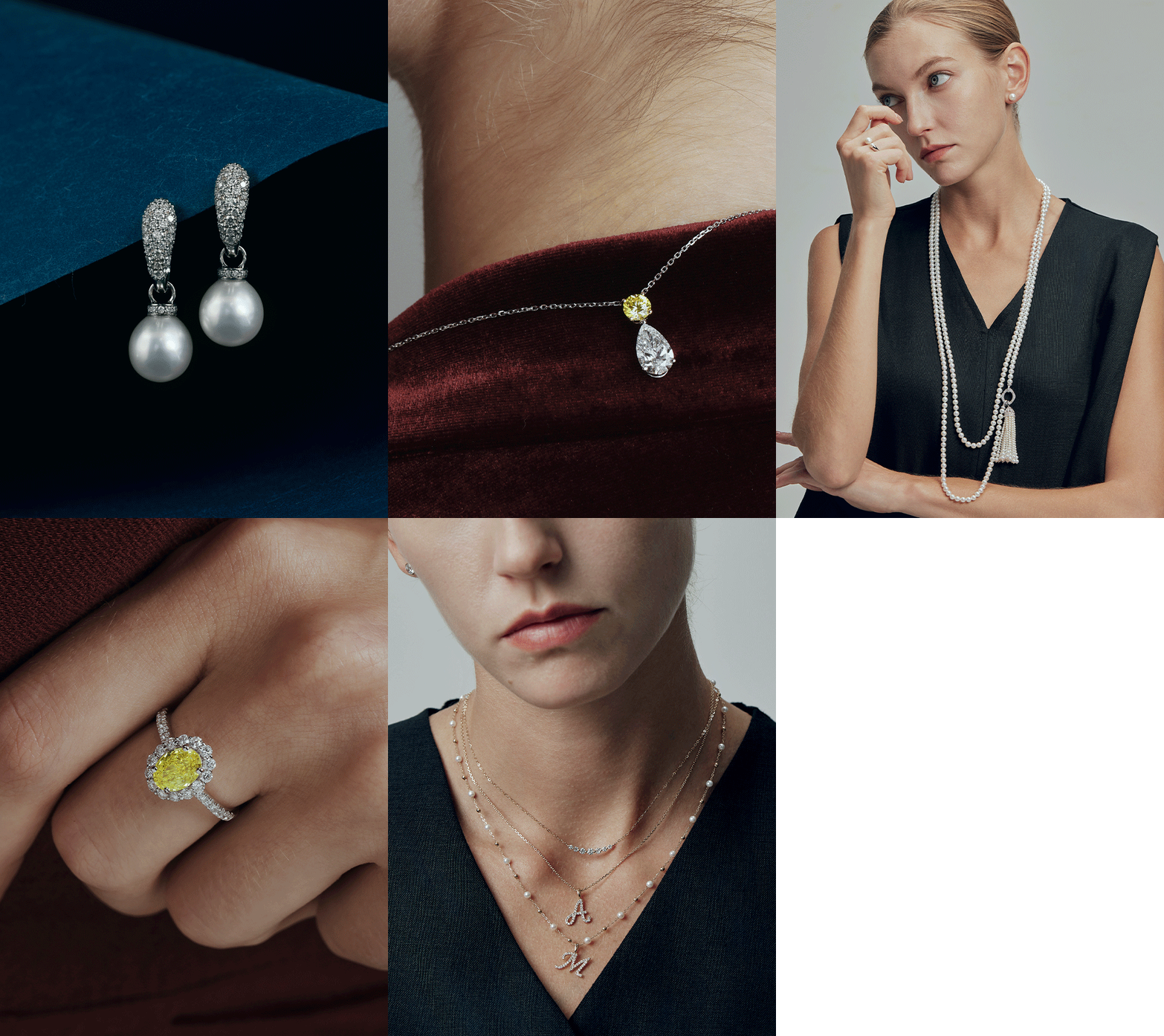


Aurora Pearl
Selected freshwater pearls known for their refined luster, surface quality, and balanced beauty.
ShopCart
Your cart is empty


THE PEARL JOURNAL / PEARL EDUCATION
Five ways to spot the difference before you buy — and why the safest way is to never have to guess.
A real pearl is built, not made — layer after layer of nacre, formed slowly inside a living mollusk. Hold one up to the light and tilt it, and you can almost see that process still happening in the way it catches and releases the glow. That is the signature nothing imitation can fully copy.
Imitation pearls have gotten harder to spot, not easier. Some look convincing in photos. Some feel polished in the hand. Some are beautiful as fashion jewelry, but they are not the same as real cultured pearls.
You do not need a lab to protect yourself, though. You need to know what you are actually looking at — and a few minutes.
Swipe to compare
| Check | Real Pearl | Fake / Imitation Pearl |
|---|---|---|
| Luster | Soft, layered luster with visible depth | Flat, uniform, or surface-level shine |
| Temperature | Cool at first, warms slowly | Often warms quickly or feels plastic-like |
| Weight | Often feels denser for its size | Often lighter, though glass imitations can vary |
| Tooth test | Slightly gritty or resistant | Smooth, glassy, or slippery |
| Drill hole | Clean, may reveal nacre layers near the edge | Chipped coating or bead underneath |
A CLOSER LOOK
Hold the pearl a few inches from a window or soft lamp and tilt it slowly.
A real pearl does not simply shine. Its luster has depth — light seems to move across the surface in layers, with a soft reflection that changes as the pearl turns. This comes from nacre, the luminous material built up slowly inside the oyster.
An imitation pearl can still look bright, but the shine often feels more uniform. It sits on the surface like a coating, without the same softness, depth, or quiet variation.
Luster is one of the most important signs to observe, not only because it can help distinguish real pearls from imitation ones, but because it is also one of the clearest signs of pearl quality.
Real pearls are cool to the touch when you first pick them up, and they warm gradually against your skin — the same way stone or glass does, because nacre is dense and mineral-rich.
Plastic and resin imitations tend to feel closer to room temperature immediately. They do not hold that first coolness in the same way.
This is a small detail, but it is one of the fastest checks you can do without any tools at all.
Pick the pearl up and let it sit in your palm for a second.
Real pearls often have a noticeable density for their size. They should not feel hollow or weightless.
Imitation pearls, especially plastic ones, tend to feel light. Glass imitations can make this test less reliable because glass also has weight, which is why this check works best alongside the others, not on its own.
This is the oldest trick in the book, and it still works.
Gently touch the pearl against the edge of your front tooth. A real pearl will often feel slightly gritty, almost like fine sand. That texture comes from the uneven, layered structure of nacre. An imitation pearl usually glides smoothly because its coating is designed to be perfectly even.
One honest caveat: very high-quality imitations can come closer to mimicking this texture, so treat the tooth test as one data point, not a verdict. It is also better not to use this test on pearls you do not own, especially in a store. Avoid repeated rubbing, as friction may damage the pearl's surface. This test is best avoided on valuable or delicate jewelry.
If the pearl is already set into jewelry, the drill hole is one of the most revealing places to look — and one of the most overlooked.
On a real pearl, the hole should look clean. You may be able to see subtle nacre structure near the edge. On an imitation pearl, you may notice chipped or peeling coating around the hole, where the outer layer has worn away to reveal a plain bead underneath.
A jeweler’s loupe helps here, but a phone camera zoomed in can work in a pinch.

A real pearl begins when nacre forms layer by layer around an irritant or inserted nucleus. Over time, those layers build into the glow, texture, and density we associate with real pearls.
Cultured pearls follow the same natural process, with one difference: the process is started deliberately. From that point on, the mollusk does the work — depositing nacre slowly, with no shortcut that can fully recreate the same result.
That is why cultured pearls are real pearls.
Imitation pearls skip this process. They are usually beads coated to resemble the surface of a pearl. Some can look beautiful, but they do not have the same nacre structure, depth, or organic formation.
That is exactly what the tests above are designed to reveal.
A Note on At-Home Pearl Tests
At-home tests can offer helpful clues, but no single method can conclusively determine whether a pearl is genuine. Some imitation pearls may resemble natural or cultured pearls in appearance, temperature, and weight. For valuable pieces or when authenticity remains uncertain, professional gemological examination is the most reliable way to confirm a pearl's identity.
Once you know a pearl is real, the next question is what kind of pearl it is.
Selected freshwater pearls known for their refined luster, surface quality, and balanced beauty.
Shop
Prized for their exceptional luster, classic round shape, and elegant overtones.
Shop
Distinguished by their naturally silver-blue tones, refined luster, and subtle color variations.
Shop
Renowned for their natural golden hues, impressive size, and rich, luxurious luster.
Shop
Celebrated for their naturally dark body colors and distinctive green, blue, and peacock overtones.
Shop
Prized for their impressive size, luminous white tones, and soft, satin-like luster.
ShopEvery pearl GINGIBERI carries is a real, cultured pearl. We do not sell imitation, simulated, or faux pearls under any name.
Each pearl is selected with attention to luster, nacre appearance, surface quality, color, shape, and overall presence before it becomes part of a piece. For paired earrings or multi-pearl designs, matching is also carefully considered, because two real pearls can still feel very different when placed side by side.
Our focus is not only whether a pearl is real. It is whether the pearl feels luminous, balanced, and worthy of the finished design around it.
If you are wearing GINGIBERI, these tests are really just a way of seeing, up close, the work that has already been done.
Yes. Cultured pearls are real pearls. They are formed through the same nacre-building process as natural pearls, with human assistance at the beginning. Nearly all fine pearl jewelry sold today uses cultured pearls.
Yes. Some fake pearls can look convincing, especially in photos. That is why it is better to check multiple details instead of relying on one sign alone.
The tooth test can help, but it should not be the only test. Real pearls often feel slightly gritty, while imitation pearls usually feel smoother. However, it does not tell you whether a pearl is high quality.
Yes, though perfectly round pearls are rarer. Round is one of the most valued pearl shapes, especially when paired with strong luster and good matching. Slight variation is normal in many real pearls, especially freshwater and baroque pearls.
Not always. Many fine pearls show a subtle overtone, such as pink, silver, green, blue, or cream, but the absence of a strong overtone does not mean a pearl is fake.
CHOOSE WITH CONFIDENCE
Learning how to tell if pearls are real can help you avoid imitation pearls. But the most reassuring choice is to buy from a source that tells you clearly what you are looking at.
Real pearl jewelry should offer more than a pearl-like appearance. It should have depth, material honesty, thoughtful selection, and a design made to last.
Explore GINGIBERI pearl jewelry crafted with real cultured pearls, quality materials, and modern fine jewelry design.